
Technology is moving so fast that it is difficult (and costly) to keep up with all the latest gear. A lot of photographers fall for the belief that new gear will make them better photographers.

Oftentimes, some of the most expensive camera gear in the world sits in closets, rarely making it out to the local park. In this article, we’re going to look at the best film cameras to help you get into the world of film photography!
Shooting film is a great way to take a photo and disconnect from your digital camera and online life.
The cheapest new full-frame DSLR will run you around $2000, and a used Canon 5D (full-frame DSLR released in 2005) will cost you around $500. If you shoot film, you can get the same full-frame quality (including a few lenses, too!) for around $100. While you do have to buy film and develop it, the skills and techniques that you’ll learn throughout this process will make you a much more efficient and thoughtful photographer in the long run.
But with so many options available, where is the best place to start?

This article is broken into two parts:
- Part 1: The best film cameras (SLR, Rangefinder, and Medium Format)
- Part 2: How to buy (without getting ripped off!) TL:DR We recommend checking out KEH Photography, as they grade all their cameras.
If you can’t do this, then please consider sharing the article on social media to help bring attention to the website. I want to keep creating quality content for everyone. The more people that I can help the better. This small act really does mean a lot to me.
Here at Cultured Kiwi, we are huge believers in analog photography. We have just completed a full Canon F1 review and a review of the best 35mm film on the market. Check them out. But, for now, we’ll continue with the best cameras.
We have since done an article teaching how you can develop your own film at home, check it out here. This helps you get a much faster turnaround time from shooting film to seeing results.
So enough with this banter, let’s get on with the show!

To help you find the perfect camera, we have broken this section down into the different types of bodies you can choose from.
The Best Film Cameras
The best film cameras are simple, affordable, and easy to use, producing beautifully crisp images.
It can be overwhelming to browse online and see how many different film camera options are available, both new and old. If you don’t know where to start when choosing one, don’t worry! We’ve done the hard work for you.
So, just check out the list and see which one ticks all the boxes for you! Most of these (with multiple lenses) can be had on KEH or Amazon (used) for under £100 or $150.
Best 35mm SLR Film Cameras
Canon AE-1

The Canon AE-1 was an unprecedented success from the moment it was released in 1976. There are no aperture priority mode, shutter speed priority, or auto modes.
You need to select your aperture setting, then look at the meter (in the viewfinder) and select the correct shutter speed.
In terms of lens availability, there are thousands of Canon FD mount lenses available, and therefore, you are able to pick up a full focal range for a relatively humble sum. Overall, it is a well-made and well-regarded 35mm body that is probably the best budget camera on the market.
Pentax K1000

You cannot look past the K1000. This film camera has long been a favorite for photography classes and beginners. It has all the manual settings and everything you need to get started.
You can find them on KEH/Amazon or at any used store. It has a huge library of lenses for you to choose from.
You can see our full Pentax K1000 Review here for more information.
Nikon FE/FM

The Nikon FE and FM were introduced in the late 1970s as lightweight, lower-cost alternatives to the flagship Nikon F2. The bigger, heavier F2 offers removable viewfinders and very high build quality.
There is only one primary difference between the two: FM’s are mechanical with manual exposure, and FE’s are electronic with automatic exposure control. Most AF and manual-focus lenses work on all of these, except the “G” series lenses. See our full Nikon FM2 Review and Nikon FE Review here.
Olympus OM-1

My personal favorite is the Olympus OM-1; in fact, I made a whole video about it. It is an excellent choice and is extremely small and light. It is a mechanical-shutter manual SLR with something of a cult following.
The through-the-lens (TTL) light meter controls a needle visible in the viewfinder, which allows you to dial in the exposure. The shutter speed dial is located around the lens mount, allowing photographers to keep the camera to the eye between shots more easily than with other cameras whose dials are located on the top plate.
You can also see our full Olympus OM-1 Review here.
Canon EOS A2 / A2E

At the time of its creation, the Canon EOS A2 (1992) was placed at the top of Canon’s EOS camera line. This one is larger than many of the others on this list, but arguably the most advanced. It has 2 dials to adjust aperture and shutter speed.
If you are already a Canon DSLR shooter, then you will no doubt already have a few lenses lying around. The great news here is that this camera uses the Canon EF lens mount. So all your new lenses will work with this one. One word of caution is that it requires 2 strange batteries, the 2CR5 6V batteries, which can be hard to come by.
There are a lot of pros and cons to using a rangefinder, especially when compared to a pro body, but they do have some advantages. The rangefinder uses a secondary focusing window through which you can line up and take your photo.
This means you can generally focus your photo more quickly, but what you see through the viewfinder isn’t exactly what you see through the lens (TTL). Great for candid shots, but terrible if you’re trying to line up the perfect composition.
Further, as your head is not directly behind the camera (usually off to one side or the other) you don’t come across as the creepy photographer as you do with an SLR and a zoom lens. Another reason these are perfect for candid photography.
Best Rangefinder Film Cameras
Contax G1

If I were to pick the best film camera for (affordable) street photography, it would absolutely be the Contax G1. The Contax is a rugged, titanium-coated rangefinder film camera and is widely regarded as one of the most advanced electronic rangefinders on the market. That was until the Contax G2 (see below) came around!
These Contax cameras came complete with a Carl Zeiss fixed lens, so the optics are second to none. They were designed to compete with Leica and Voigtlander lenses and have proven successful. The G1 is on the market at around 5x less than the G2, so if you’re in the market for a deal, check it out.
You can also see our full Contax G1 Review for more information about the Contax G1.
Canon Canonet G-III
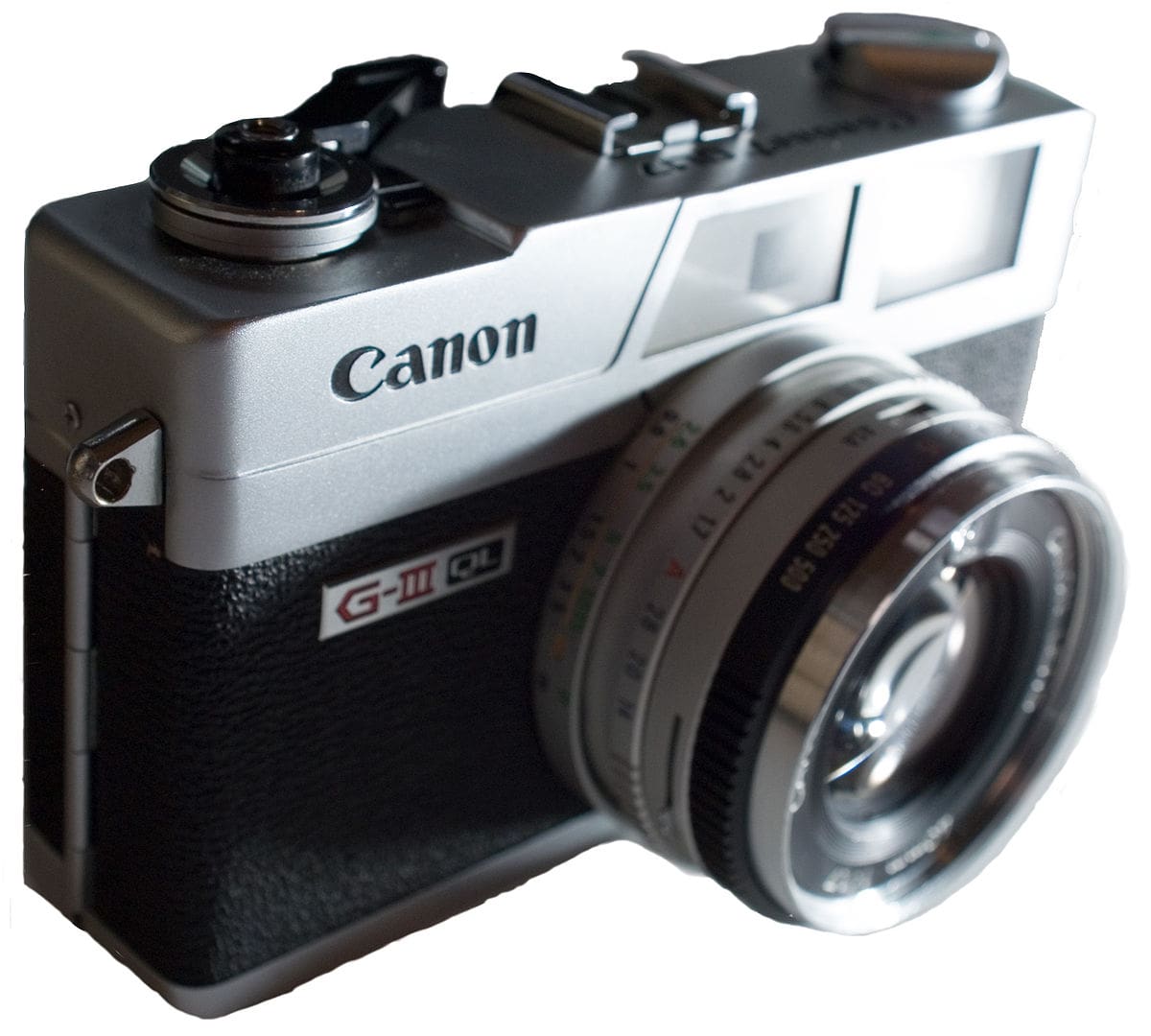
No list of the best film rangefinders would be complete without mentioning the Canonet G-III. It was the best-selling 35mm rangefinder of all time. It has a fixed lens and full manual control. But further to this, it has shutter-speed priority and auto modes, making it great for beginners.
QL stands for quick loading, and 17 refers to the fixed-mount 40mm f1.7 lens attached. The photos come out beautifully, and they have received nothing but exceptional reviews for their image quality.
Best Point-and-Shoot Film Cameras
Ricoh GR21

Ricoh introduced the GR21 in 2001, making it the first compact camera to have an ultra-wide lens. You can take amazing shots with this one – it’s popular among street photographers in particular. When shooting like this, speed is essential, making a point-and-shoot camera the obvious choice.
See also our Best Point-and-Shoot Camera Under $300 for more digital options.
The Ricoh GR21 has a 21 mm lens, multi-autofocus, and automatic exposure control and compensation. This highly-rated model is pretty expensive now, but if your budget allows, it’s worth the investment. You’ll be wowed by the high-quality, super-crisp, clear images it can produce. The wide-angle lens is second to none, and you get incredible, saturated, vibrant colors, too.
Nikon 35/28 Ti

The Nikon 35 and 28 Ti models date back to the early 1990s; they’ve stood the test of time. Nikon first introduced the 35 Ti, followed the next year by the wide-angle 28 Ti camera.
You might be wondering what the ‘Ti’ means. Here, it refers to the titanium that Nikon and other camera manufacturers used for the first cameras. So while this camera is an excellent and durable choice, it does weigh more than some of the other cameras on this list. You can also see our Nikon F100 Review here.
The Nikon 35 Ti is kitted out with a 35 mm Nikkor lens, while the wide-angle 28 Ti has a Nikkor 28 mm lens. One of the top advantages of these cameras is that you can switch off the autofocus, allowing you to play around and get creative with your shots. Not many cameras will allow you to do this.
You’ll find that both cameras can produce fantastic photos with high contrast and clear detail.
Konica Hexar AF

The Konica Hexar AF is another brilliant vintage camera. If you’re into all things retro, you’ll love this camera! Not only does it look cool, but it’s super portable and lightweight. It resembles a rangefinder, but it’s actually a simple point-and-shoot camera.
While the Konica Hexar doesn’t have the full range of controls that a pro camera should, it’s an ideal option for beginners or hobbyist photographers. The image quality is impressive, with very little distortion. The Konica Hexar AF is a versatile camera that you can quickly get the hang of and take anywhere!
Yashica T5

This little point-and-shoot camera also dates back to the ’90s and remains popular today. In fact, the cost of the Yashica T4 and T5 has continued to rise over the years, making them among the more expensive compact cameras today.
The Yashica T5 might not look like much with its seemingly cheap plastic build, but it’s a great compact camera for street photography. With this model, Yashica introduced a cool feature that shows the view through the viewfinder on the top of the camera. This enables candid photographers to compose and capture amazing images from waist height.
The Yashica T5 has a fantastic 35 mm Carl Zeiss lens and faultless autofocus feature. It’s also weatherproofed, so you can use it come rain or shine. You’ll take crisp, high-quality images with this camera!
See our full Yashica T4 Review here for more information.
Olympus MJU-II

If you’re after a camera that can handle all the tricky focusing, aperture, and more, go for the Olympus MJU-II. Olympus carefully honed the automatic controls so you can focus on what’s happening around you and capture those perfect moments.
The Olympus MJU-II is the best film camera for automatic shooters, capable of handling a range of situations and lighting conditions. Combine this with a fast maximum aperture and built-in flash, and the result is a very versatile camera. If you go for the Olympus MJU-II, you won’t waste time fiddling with buttons and miss that perfect photo. For photographers who want to spend more time taking photos, this is the one for you.
Leica Minilux

The Leica Minilux isn’t just a point and shoot for beginners – experienced photographers and even professionals will enjoy shooting with it. Durable, sophisticated, and offering extensive manual controls, this Leica is an incredible camera.
Although some die-hard Leica fans are put off by the fact that the Minilux was produced in Japan by Minolta, it performs like any other Leica. You’ll love shooting with this little beauty. It looks cool, with its streamlined, sturdy, and minimalist design. The exposure system is center-weighted and performs well, making it easy and convenient to take great photos. The Leica Minilux is an all-around performer in the point-and-shoot range.
Contax T2

The Contax T2 is a solid contender for the best point-and-shoot camera. A lot of thought has gone into creating a smooth user experience, including a clear viewfinder and quiet shutter button. You also have the option of manual focusing, if you crave more control over your shots.
This camera feels weighty and reassuringly hardwearing in the hands due to the titanium build. One drawback to this one is that the lens is located very close to the right-hand grip – close enough, in fact, that you risk obscuring the lens with your finger. Other than this, the Contax T2 is a reliable, simple point-and-shoot camera.
If you want to learn more about manual focusing, see our post on How to Use Manual Focus here.
Olympus XA

The Olympus XA is that rare thing – a 35 mm film compact camera with a rangefinder. Introduced in 1979, the Olympus XA was designed by Yoshihisa Maitani, head of design at Olympus. With an all-new lens (for the time) and stylish design, it reached cult status among photographers. The XA was revolutionary and has influenced camera development over the decades.
If you’re looking for a point-and-shoot camera suitable for professional photographers, the Olympus XA should tick the right boxes. It’s tiny, but it doesn’t lose any of the functions a point-and-shoot should have. You can easily carry it with you anywhere, enabling you to take even more photos.
The Olympus XA was first introduced in 1979 and has reached cult status among photographers. While the Olympus Stylus Epic can shoot at higher ISO speeds than the Olympus XA, the XA wins for capturing candid images. It’s also better when you want more control over DOF.
Fuji Klasse S/W

The Klasse S and the wide-lens Klasse W are Fuji’s additions to the range of compact cameras available today. They bring point-and-shoot cameras firmly into the modern era, boasting an incredible EBC Fujinon lens, a user-friendly viewfinder, and a high-quality, durable build. Many cameras of this sort seem outdated now, but you can’t say the same for the Fuji Klasse S and W models.
The Fuji Klasse W has a 28 mm lens, while the Klasse S has the standard 35 mm lens. Otherwise, both models perform well and take clear images with superb contrast and detailing. It’s easy to switch from automatic mode to Aperture Priority mode.
These outstanding cameras compare well to even the latest digital camera and are a perfect choice for street photographers. Lightweight and portable, the Klasse S or W delivers amazing results. If you’re after advanced controls and features, you’ll find them here.
Best Medium Format Film Cameras
If you are interested in picking up a medium-format camera, we recommend the following. It is a little more expensive, but the images produced are absolutely amazing!
Yashica MAT 124 TLR

There are a number of Twin Lens Reflex cameras on the market, but the Yashica MAT 124 is by far the best value for money. It basically is a copy of a Rolleiflex, almost right down to the controls, but not the cost. It can take either 120 or 220 medium format film and has all manual controls. If you would like to try to shoot square format film or scratch that medium format itch, this is your camera.
Kiev 88

As we move through our knockoff cameras, we inevitably arrive at the Kiev 88. It is a Ukrainian copy of a Hasselblad, which retails for around $600. This set-up can be had with a lens for around $250. They have a bit of a bad reputation for being poorly made and easily broken, but they produce some amazing results. Like other medium-format cameras, they are a little heavy, but the quality of the shots is worth the pain.
For more information about the Hasselblad, see our full Hasselblad 500C M Review here.
Mamiya RB67

This is a medium-format system. It records images on a 120-format roll. Each frame is roughly 6cm by 7cm. This is 5 times the imaging area of a full-frame DSLR. The resulting images look different, especially in portraiture with longish lenses. The Mamiya RB67 is a beast of a camera at 2.5kg without any lenses. It was mostly used for studio photography, but if you want to carry it into the wild, you are sure to capture some very unique photographs!
What should I look for when buying a film camera?
Before purchasing a new film camera, you should consider the following:
How much do you want to spend?
When buying anything, this should always be the first factor you consider. You can always spend a little more money for a little more functionality, but that doesn’t necessarily translate into a better product for you. Compare prices and be realistic about what you want and how much it should cost. Something that seems too good to be true is usually too good to be true.
Don’t forget to consider the resale value of your potential camera system. Sometimes, buying cheaper gear means you end up with something you can’t sell if you change your mind. Buying camera gear with a high resale value lets you try out an amazing system and sell it later without losing any money. Look at Leica cameras if you want to go for the top end and have the best chance of resale. For your first film camera, I suggest you keep reading and look at something a little more friendly on the wallet.

What type of film camera do you want?
Are you looking for an SLR or a rangefinder? Perhaps you would like to get into medium-format photography? You need to begin by deciding on what type of photography you’ll be doing with your new (old) camera.
As film cameras are generally pretty cheap, you can pick up a rangefinder for candid photography or an SLR film format for landscape photography. There are so many options around the $100-200 range that you can find something that best suits your needs.

What functions do you want?
Do you want a fully manual camera, or would you like some of the exposure settings calculated for you? I prefer manual cameras, as they rely less on batteries or technology. Old camera batteries are notoriously difficult to find!
The one function I would try to keep an eye out for is an inbuilt light meter. This negates the need for a lot of guesswork with exposure settings or fiddling with an exposure app on your smartphone.

How much do accessories cost?
I am an advocate for the one-camera, one-lens policy whenever possible. This will help you quickly improve your photography by forcing you to move around to take in the scene. You then get creative by forcing yourself to go low rather than standing up and zooming in. Sometimes, when you change perspective, the image becomes vastly different. Starting with one camera and one lens ensures you get more consistent results over time.
That said, it is important to know what the accessories cost. Are there many lenses available? If so: how much do they cost? It all basically boils down to doing your research. Learn everything you can about the camera and the lens mount system prior to purchasing.
You can check out our 7 Must-Have Camera Accessories here for more information.

What condition is the camera in?
The number-one killer of any camera or lens is mold. Keep an eye out for any mold, and if you see it in the lens elements, then do not buy it. Check the overall physical condition for signs of being dropped.
Make sure that all of the dials and switches work properly. Take a “photo”. Open and close the film loading mechanism to check that. You can also see our full article on How To Load Film here. Lastly, I like to give it a light shake to see if there are any obviously broken, bad-sounding parts inside.

So that is the list of important considerations. If you are not in a store buying the camera (buying online) then send some of these questions to the seller. Make sure they are reputable and have a track record of selling to satisfied customers. Just do your research before pressing buy now!
Frequently Asked Questions (FAQ)
Here, you’ll find the answers to the most common questions people have about point-and-shoot film cameras!
Is the Pentax K1000 a good camera?
The K1000 is a good camera, especially for a beginner. It is a fully mechanical shutter, fully manual 35mm SLR camera that was quite common. This means there are many lenses and accessories. It was popular among students and beginner photographers.
What is the best vintage film camera?
The best vintage camera depends on what you intend to shoot with it. A rangefinder is great for candid photography, and a large format is good for shooting models. See our full guide to see which camera will best suit your needs.
Which camera is the best?
To find out which film camera is best for you, you must first decide exactly what you intend to shoot and what your budget is.
Do professional photographers still use film?
Yes. A number of professional photographers use film today. While there are relatively few reasons to use film rather than a digital camera, most have long-term projects that require a particular film stock.
Are 35mm film cameras still being made?
Only a few 35mm film cameras are still being made and can be purchased new. The Nikon FM-10 is one of these cameras. But there are plenty of used cameras in excellent condition that can be purchased.
Are film cameras making a comeback?
Film cameras are making a comeback. The backlash from millennials has led to a resurgence in the number of film manufacturers producing 35mm and medium-format film stock for vintage cameras.
Is a film camera better than a digital camera?
Film cameras are better than digital cameras for some reasons, but in most cases, they are not. If you are learning photography, film cameras can be a great way to help you master the basics of exposure.
What is a point-and-shoot camera?
A point-and-shoot film camera is designed to be simple and easy to use, producing prints rather than digital images. Although film cameras are less common than they used to be, shooting film photography is a great experience. Anyone can use a point-and-shoot film camera thanks to helpful features like autofocus and automatic exposure settings.
What is an automatic camera?
An automatic film camera is just another term for the point-and-shoot film cameras that we have featured in this review. They automatically select the correct exposure and focus. All you have to do is point your camera, click, and capture the moment forever!
What are the best film cameras?
There’s a wide range on the market, ranging from the simple shoot-and-point 35mm camera to the more complex SLR film format camera. Wherever you are on the spectrum from beginner to pro, you’ll find the right camera for you.
Some of the top regarded camera manufacturers include Canon, Nikon, Leica, Lomography, and Olympus. You won’t go wrong with any of these well-respected brands.
Wrap Up
Point-and-shoot cameras are ideal for beginner and hobbyist photographers; SLR film format and Rangefinders are more suitable for professionals in the photography business. The film cameras are durable, lightweight, and easy to use, capable of producing high-quality, striking images.
If you’re not sure which to choose, our list should help you pick the best option for you! They come in a range of prices, from budget to more expensive, original models from the ’80s and ’90s. Whether you’re after a small, simple camera for travel photography or shooting street shots, you won’t go wrong with these highly-rated cameras. So what are you waiting for? Grab one, get out there, and start snapping!
So pick yourself up one of the cameras above and get a few rolls of film under your belt. There is nothing like the excitement of getting a rollback from the lab and holding the fruits of your labor. Trust me, you will love it. Remember #filmisnotdead!! Happy shooting, everyone.
Ben – Cultured Kiwi



Thanks for a fantastic article. I think I’ll pick up an FM2
I have a AE-1 they’re the best!
I really like the Nikon FM2 cameras. Your article on it was fantastic!
I’m a long-time Pentax user but I don’t understand the universal love for the K1000. Yes, it was a fine starting point when it was abundant and cheap, but that was 20 years ago and this new reputation as the ‘perfect starter camera’ has jacked up prices above those of much more capable machines. Why buy a K1000 when you can have an MX for less – or an ME Super for much less?
But if it has to be back-to-basics all-manual, I think the real competition for the K1000 comes from Nikon – or rather, came from Nikon several years before Pentax conceived the K series. A Nikkormat FTN shares all the K1000’s solid-but-basic credentials, adds a couple of useful features that stay out of the way until you need them, yet can be had for peanuts, even as film camera prices escalate: 80-100 dollars, euros or pounds ought to buy one with a 1960s 50mm f/2 Nikkor-H (or pay an extra 20 for a 1970s AI 50/1.8 if you want the option to move on to a more modern Nikon later.) Whatever the internet says, it will meter happily on a modern EPX625G battery. It’s not a tactile and ergonomic delight like the FE (or the ME Super) but it is – literally – a lot of camera for the money, and seems like better value than a K1000 in today’s film camera market.
I would personally recommend looking at Pentax Spotmatic series. It is older, cheaper and uses the M42 screw mount, which was much more universal and widespread than K-mount. Lot’s of cheap lenses. My first kit was 30$ for the body and 0$ for a Helios 58mm f/2 lens (it’s Russian, I took it off of an old Zenith I had, but these were super cheap then, now the price is around 35-60$).
Pentax Spotmatic is fully manual, the battery for the light meter lasts years. Spotmatic F had a bit better light meter, so I would recommend it over Spotmatic SP. Pair it with a prime SMC Takumar lens and you have a great film camera.
My camera repair tech agrees with Clive, he thinks Nikkormats are the best value in film cameras today. I prefer Pentax myself.